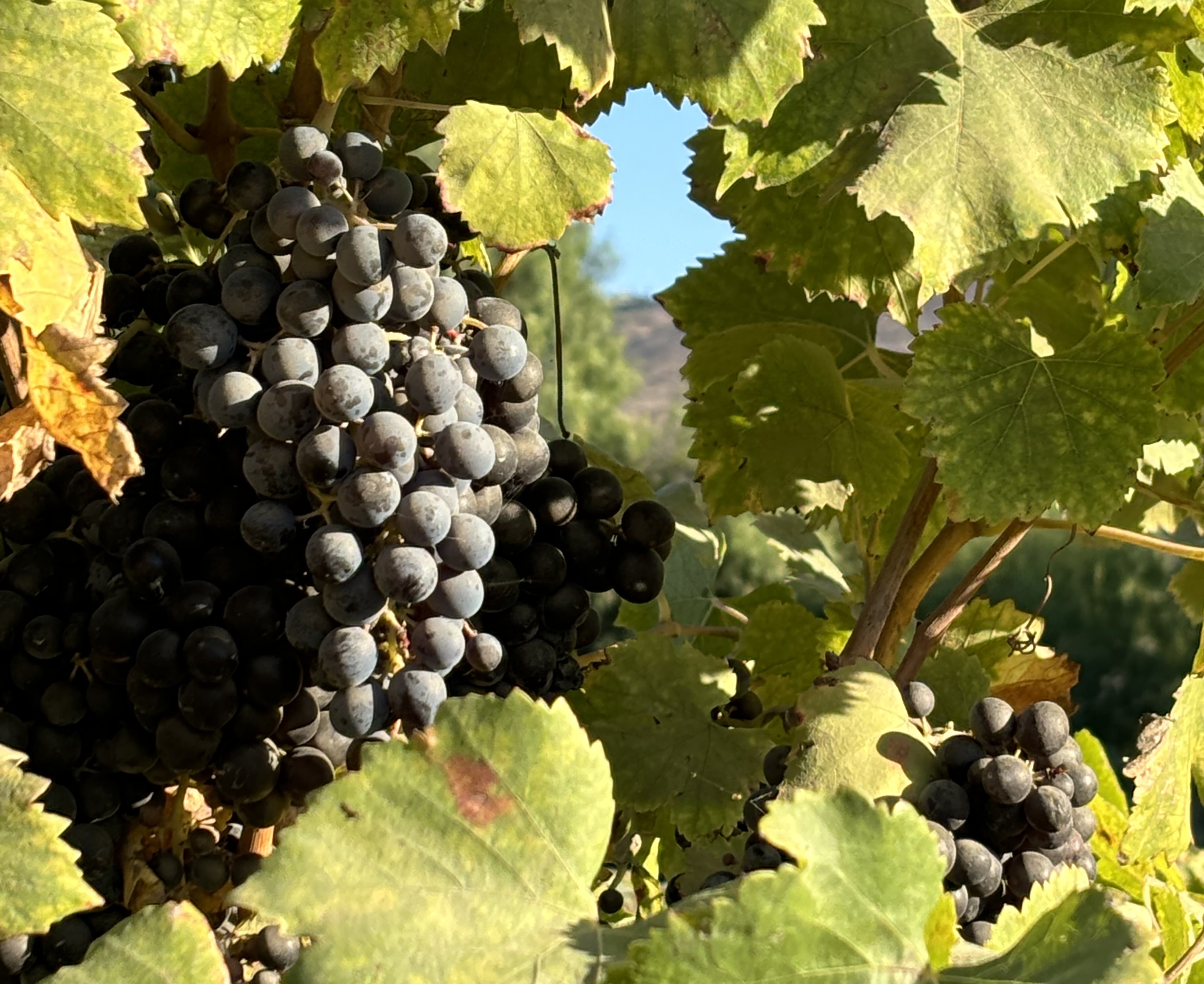
Grenache: At home in Southern California
Grenache occupies an odd place in the wine world. It is one of the most widely planted grape varieties on earth, yet people consistently tell us that they have never heard it. That says a lot about its historic supporting role in the background of great wines as a blending grape, but in the right location, Grenache is absolutely the star of the show.
Grenache is a grape that can be easily misunderstood.
Its color in the glass is often lighter than expected and atfirst, you assume that it is lacking in flavor. Its tannins aren’t pronounced,like Syrah, so you assume it won’t age. Yet time and again we find thatGrenache produces intriguing wines of remarkable complexity, texture, and senseof place; and they continue to evolve in the bottle.
We often pour Ventura County Grenache blind for customers, who guess it is Pinot Noir.
At Cavaletti, we are drawn to varieties that express place.Grenache is one of those varieties. It is drought tolerant, naturally adaptedto warm climates, capable of producing exceptional wines from old vines, andexpressive enough to communicate where it was grown, rather than simply how itwas made.
Those qualities have allowed Grenache to thrive forcenturies throughout the Mediterranean world, and they may prove even moreimportant in the decades ahead.
A Brief History of Grenache
Most evidence points to northeastern Spain as Grenache's birthplace, where it is known as Garnacha.
From there it spread throughout the Mediterranean, eventually becoming one of the defining grapes of Southern France and becoming a key variety in Chateneuf-du-Pape, Gigondas, and Languedoc. Today it is planted across Spain, France, Australia, Sardinia, and California, making it one of the most widely cultivated wine grapes in the world.
Yet despite its global reach, Grenache remains closely tied to the warm, dry landscapes where it evolved. Places like coastal California with Mediterranean climates – warm, dry summers and cool, wet winters. Unlike varieties that require significant irrigation or careful climate management,Grenache is remarkably comfortable in challenging conditions.
Why Winegrowers Love Grenache
Grenache is a giver in the vineyard. It’s natural tendency towards productivity rewards thoughtful farming and restraint.
The variety develops extensive root systems that allow it to thrive in dry conditions. It performs well in rocky soils, requires very littleirrigation, tolerates downright hot temperatures.
All of those traits also make Grenache a challenge to farm well. It seems to be affected by windy and damp springs during flowering more than other varieties. Poor fertilization often leads to clusters with only a few berries and yields can vary from year to year. In Ventura County (where we often have misty mornings during flowering) - we have seen blocks that produce 2-2.5 tons in a normal year produce only ¾ of a ton in other years. In a spring with good fertilization, it will easily produce too much fruit to ripen, and thinning clusters through green harvesting is important for quality. Give it too much irrigation-and it will produce soccer-ball sized clusters of gigantic, dilute berries. We find it important to make sure the vines have enough water, but not so much that its vigor gets out of control. This is also important because its thin skins naturally provide relatively little color and tannin so a low juice-to-skin ratio is incredibly important for color, tannin, and flavor. However, push that too far with really low yields and the grape can accumulate sugar quickly, far ahead of flavor development. What it requires is balance, restraint, and care.
Harvest for Grenache is later in the season, after Syrah, but before Cabernet Sauvignon and Mourvedre in the same climate. In most years that is around the third week of October in coastal Ventura County. Grenache holds acid really well and picking decisions are often influenced more by waiting for pH to rise than for sugar (22.5-25.5 brix at harvest). One thing to note is that we find Grenache really develops color late. It doesn’tuniformly darken over veraison like other varieties and the last week or two of ripening can yield big improvements in depth of color. That being said – some clusters always remain lighter colored at harvest if you don’t choose to drop themearlier in ripening.
Grenache in the Cellar
Grenache is the most aromatic fermentation of the season.There is a characteristic licorice smell in the winery whenever Grenache is fermenting. It is a variety that requires checking sugars after crush for a few days. It is common to see brix rise and the grapes release sugars into the must over a 48-72 hour cold soak. Whole cluster stem inclusion improves aromatics and tannin on the variety, and we aim for 20-25% stem inclusion in the finished wines. Some lots are fully destemmed, while others can be full stem-inclusion.We find that the decision on stems is more site dependent than anything. It works in some locations, and less so in others.
In barrel, Grenache takes a fairly long time to settle. The thickest lees always come from barrels of Grenache and we find that 16-22 months is optimal for bottling the wine unfiltered. Shorter elevage and earlier bottling (for example during years with higher pH) requires multiple rackings, and often a rough filtration for absolute clarity of the wine.
Our aging is done typically in larger format neutral puncheons (500 liters), and a small amount of once-used French oak.
Blending
More often than not - we find that 100% Grenache ends upbeing our favorite rendition of a vintage. Sometimes though – a little blendingproduces a better wine. Graciano,Mourvedre, and Petite Sirah have performed best, but we’ve also utilized small amounts of Alicante Bouschet, Semillon, Tempranillo, and Syrah at times.
Why Grenache Feels at Home in Ventura County
The longer we work with Grenache, the more convinced webecome that it should be one of the signature grapes in Ventura County.
Its Mediterranean origins make it naturally suited to our climate. It thrives in dry summers, tolerates heat, responds well to thoughtful deficit irrigation, and consistently produces wines with freshness and character despite warm growing seasons. As California winegrowing continues to adapt to changing weather patterns and increasing water scarcity, Grenache looks less like an alternative variety and more like a logical one.
More importantly, Grenache tells the truth about where it isgrown.
It is not a variety that hides behind heavy oak, massive extraction, or sheer concentration. Vintage variation shows. Site differences show. Farming decisions show. In our experience, few grapes communicate place as clearly.
That transparency is part of what keeps us fascinated by the variety. A Grenache grown in Ventura County does not taste like one grown in Châteauneuf-du-Pape, Priorat, McLarenVale, or even Paso Robles. It tastes like Ventura County. It reflects our soils, our cool weather and long growing season, and the decisions made in the vineyard throughout the year.
Perhaps that is why we focus on Grenache year after year. It is a grape that rewards patience, observation, and restraint. It asks a great deal from the grower, but when everything comes together, it produces wines of remarkable perfume, texture, and complexity.

